Five knives sounds like too many until you realise what you’re doing wrong.
Most home cooks buy knives like they collect spices: one for every tiny purpose, none of them quite right. The truth is you need five good knives, not fifteen mediocre ones. Each has a job it does better than anything else, and the trick is knowing which job belongs to which blade.
The chef’s knife is your workhorse
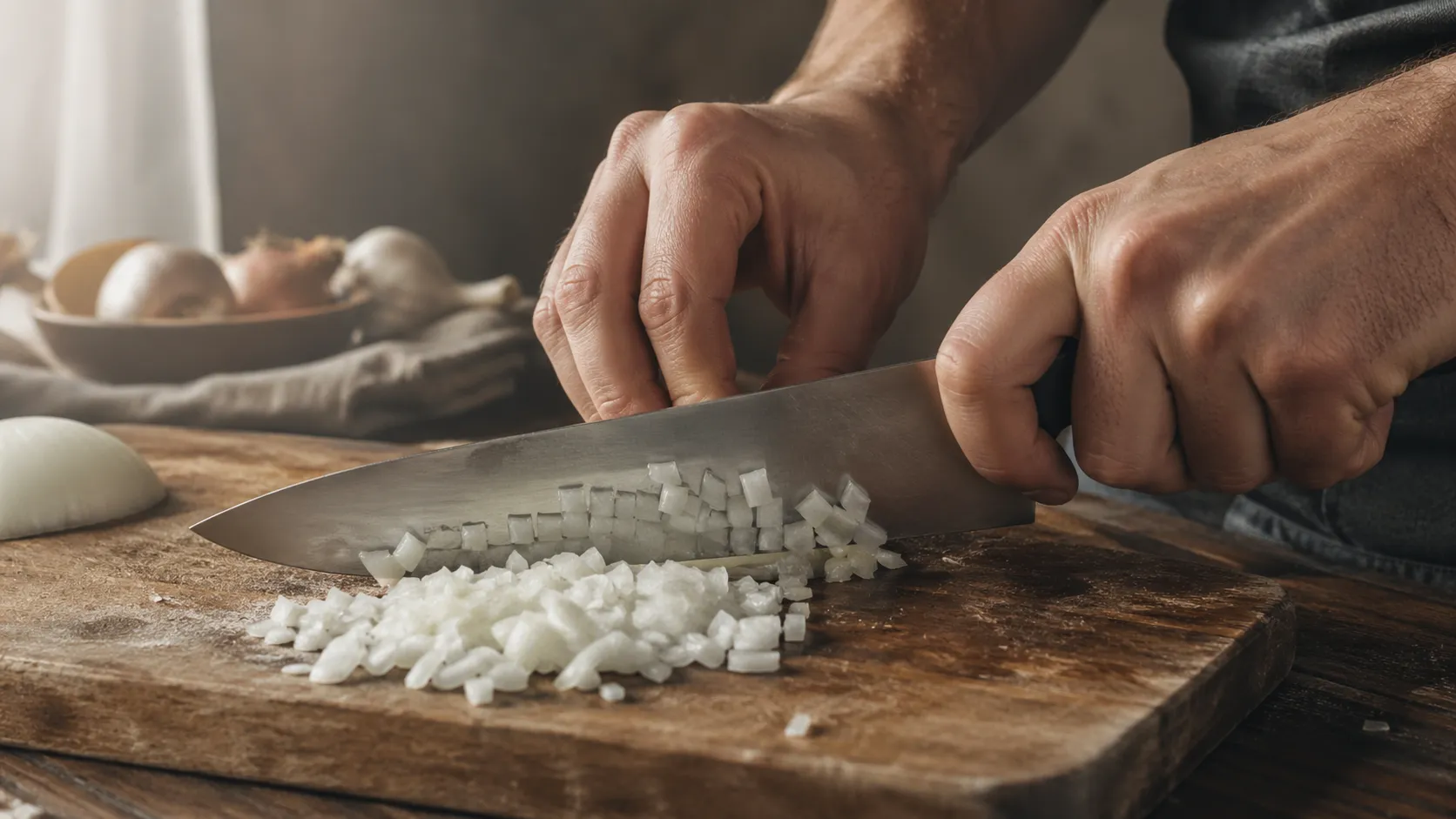
Your chef’s knife does 80% of everything. Chopping onions, dicing carrots, breaking down peppers, crushing garlic with the flat of the blade. If you only afford one good knife, make it this one.
The length, usually 20 to 24cm, lets you rock through herbs and vegetables efficiently. The weight helps it fall through food without forcing it. Hold it by pinching the blade base with your thumb and index finger, then wrap your other three fingers around the handle. That grip gives you control without fatigue.
The paring knife for precision work
When your chef’s knife is too clumsy, reach for the paring knife. Peeling apples, coring strawberries, deveining prawns, trimming mushrooms. Anything that happens in your hand rather than on a board.
The short blade (8 to 10cm) gives you fingertip control. Use it for anything requiring detailed cuts or working with small ingredients. It’s not for chopping. That’s asking the knife to do the wrong job.
The serrated knife isn’t just for bread
Yes, it cuts bread. But it also cuts tomatoes, citrus, cakes, and anything with a delicate skin that resists a straight edge. The saw-like teeth grip and tear through surfaces that would otherwise squish under pressure.
Don’t press down with a serrated knife. Let it saw gently through the food. The knife does the work; you just guide it. A 20 to 25cm blade handles everything from crusty loaves to soft tomatoes without crushing them.
The utility knife bridges the gap
Too long for paring, too short for serious chopping. That’s precisely why the utility knife exists. It’s the knife you grab for medium tasks: slicing cheese, cutting sandwiches, trimming meat, scoring vegetables.
A 12 to 15cm blade feels nimble but substantial enough for board work. It’s the knife you reach for when the chef’s knife feels like overkill but the paring knife feels inadequate. Many home cooks skip this one, then wonder why nothing feels quite right.
The boning knife for anything with bones
Even if you never break down a whole chicken, a boning knife is useful. Deboning fish fillets, trimming silver skin from meat, frenching lamb racks, working around joints. The narrow, flexible blade curves around bones and contours that straight blades can’t follow.
The flexibility is the point. It yields to pressure rather than forcing through. This means less waste and cleaner cuts. You don’t need it every day, but when you need it, nothing else will do.
How to tell if you’re using the wrong knife
If you’re forcing the knife through food, you’re probably using the wrong one. If your hand cramps after five minutes, the grip or weight is wrong for the task. If food squishes or tears instead of cutting cleanly, switch blades.
Good knives feel like extensions of your hand. The right tool makes the technique obvious; the wrong one makes everything feel like a struggle.
Sharpness matters more than price
Five sharp, inexpensive knives outperform five dull, expensive ones. Sharp knives grip food instead of sliding off it. They require less pressure, which means more control and less accidents.
Learn to use a whetstone or find a good local sharpener. A properly maintained cheap knife serves you better than a neglected premium one. The craft isn’t in owning knives. It’s in keeping them ready to work.